Oceanus
Matter-scoped legal AI workflow suite where every action belongs to a matter, every output is a cited draft, and nothing ships without attorney approval.
- Role
- Product strategy, system architecture, workflow and interface design, engineering
- System type
- Legal workflow platform
- Disciplines
- Strategy · Intelligence · Engineering · Operations
- Technology
- TypeScript, React, LLM orchestration, Retrieval, Citation grounding, Postgres
Key challenge
Design AI assistance a law firm could actually adopt: everything scoped, cited, and approval-gated — so the system's convenience never outruns the profession's duty of care.
The situation
Attorneys were already using generic AI tools informally — pasting matter details into consumer chatbots with no scoping, no citations, and no record. The capability was clearly valuable; the way it was happening was clearly unacceptable.
The problem
Legal work is matter-scoped, confidentiality-bound, and professionally accountable. Any AI assistance had to live inside those rules: context isolated per matter, every claim traceable to a source, and a licensed attorney approving anything before it became work product.
The constraints
Confidentiality between matters was absolute — no context could leak across them. Outputs had to be drafts by construction, not by disclaimer. And the interface had to fit attorneys' existing workflow, because a tool that requires a process change simply would not be adopted.
The system
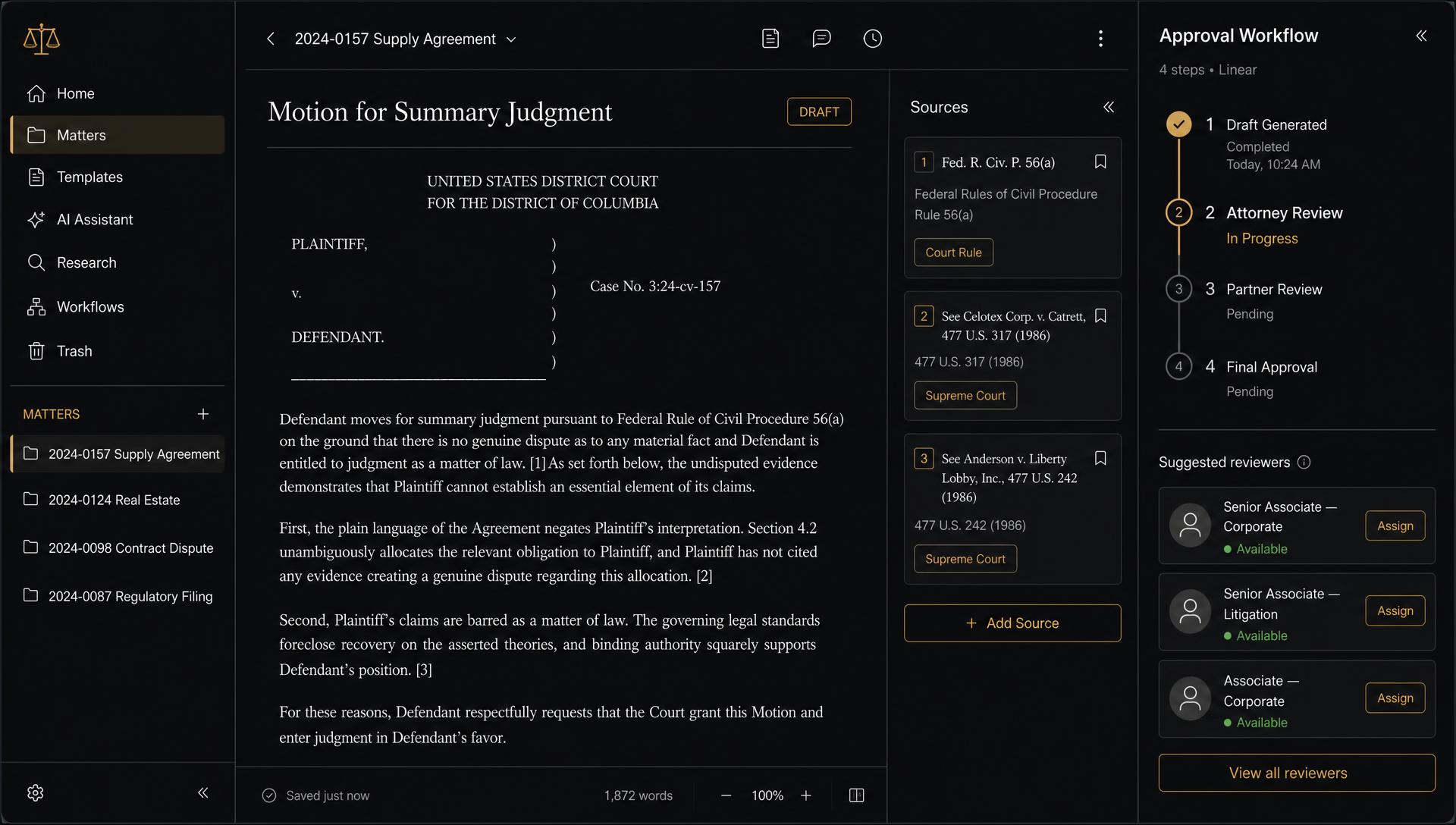
Oceanus is a workflow suite built around the matter as the unit of everything. Research, drafting, and summarisation all run inside a matter's scope, draw only on that matter's documents and approved sources, produce cited drafts, and route through an approval step before anything is finalised.
Architecture
Every entity in the system — document, draft, query, citation — carries a matter boundary enforced at the data layer, not the interface. Drafting runs through retrieval over matter-scoped sources, and each generated passage carries its citations. Approval states are first-class, so 'unreviewed' is a visible, queryable condition.
Interface
The matter is the home screen: its documents, its drafts, its pending approvals. A draft reads as a working document with inline citations an attorney can verify in place, and approving, editing, or rejecting a section is a single action with a full audit trail.
Intelligence
The AI is deliberately positioned as a junior with perfect recall: it drafts, cites, and summarises, but it cannot send, finalise, or publish. That constraint is what lets attorneys use it aggressively rather than cautiously.
Execution
Led product strategy and architecture, and designed and built the workflow, the citation-grounded drafting layer, and the interface. The suite gave the firm a governed way to get the leverage attorneys were already seeking on their own.
Lessons
Early prototypes treated approval as a final checkbox. Moving it into the centre of the data model — as the state everything passes through — simplified every other part of the system.
Outcome
Attorneys gained drafting and research leverage without ceding control: AI output arrives as cited drafts inside a matter's context, and professional judgement stays the gate on everything that leaves the building.
Architectural insight
In professional services, adoption is a trust design problem — the approval workflow is not friction around the product, it is the product.