Nereus
Website knowledge base agent that lets SDRs answer live prospect questions with grounded, up-to-date answers.
- Role
- Product design, agent architecture, crawling and indexing pipeline, frontend
- System type
- SDR knowledge agent
- Disciplines
- Intelligence · Design · Engineering
- Technology
- TypeScript, React, LLM orchestration, Web crawling, Semantic indexing, Retrieval
Key challenge
Answers had to be fast enough for a live sales call and grounded enough that an SDR would stake a deal on them — stale or invented detail was worse than no answer.
The situation
A sales team's prospects asked detailed product and pricing questions on live calls. The answers existed — scattered across the company website, docs, and changelogs — but finding them mid-conversation was impossible, so SDRs either guessed or promised to follow up.
The problem
Follow-up emails killed momentum, and guessed answers created worse problems later. The team needed an agent that could be interrogated live, in the middle of a call, and answer only from what the company had actually published.
The constraints
Latency was measured in seconds of dead air on a call. The knowledge base changed constantly as the site was updated. And an answer the SDR could not verify in one glance was an answer they would never use.
The system
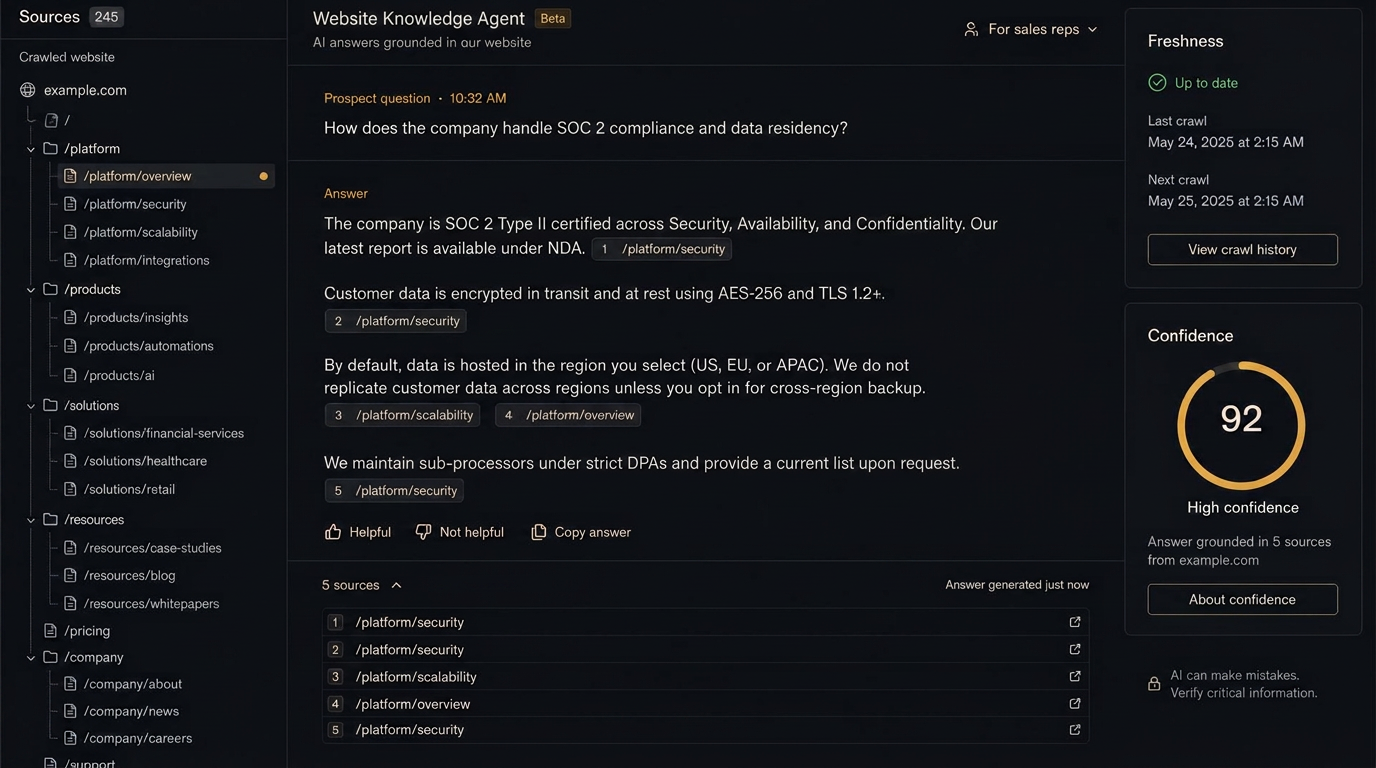
Nereus continuously crawls the company's public site and documentation, indexes it semantically, and answers natural-language questions through a retrieval-grounded agent that cites the exact page and passage behind every claim.
Architecture
A scheduled crawler diffs the site and re-indexes only what changed, keeping the knowledge base current without full rebuilds. Questions go through retrieval first; the language model's job is to compose an answer strictly from the retrieved passages, each one carried through as a citation.
Interface
Built for a call in progress: one input, an answer in seconds, sources one click away. The crawled site tree sits beside the answer so an SDR can see coverage at a glance — including what the agent does not know, which it says plainly instead of improvising.
Intelligence
Grounding is enforced, not requested. The agent answers from retrieved passages or declines, which is what makes it safe to use in front of a prospect. Uncertain questions route to a suggested follow-up rather than a confident guess.
Execution
Designed and built the crawling and indexing pipeline, the grounded answering layer, and the call-speed interface. Usage settled into the team's daily workflow — the agent became part of how calls run, not a demo.
Lessons
The decision to let the agent say 'I don't know' was debated and nearly removed. In practice it was the moment the team started trusting it — reliability is defined by the failure mode, not the demo.
Outcome
SDRs stopped putting prospects on hold to chase answers. Live questions get answered on the call with sources attached, and the team trusts the agent enough to use it in front of customers.
Architectural insight
In a sales context, the citation is the feature — an answer without a source is just another thing to double-check.