Aegir
Litigation evidence agent that classifies, tags, and triages case documents to dramatically speed up review workflows.
- Role
- System design, classification pipeline, review interface, frontend architecture
- System type
- Legal evidence agent
- Disciplines
- Intelligence · Engineering · Operations
- Technology
- TypeScript, Python, Document processing, LLM classification, Postgres, React
Key challenge
Legal review demands defensibility — every classification had to show its reasoning and confidence, and anything uncertain had to route to a human rather than quietly pass through.
The situation
Case teams were receiving evidence as bulk document dumps — thousands of files in mixed formats with no structure. Before any legal thinking could start, someone had to open every document and decide what it was.
The problem
Manual triage consumed the most expensive hours on the case and was also the most error-prone at scale: fatigue sets in exactly where consistency matters. The team needed first-pass classification they could defend, not just accept.
The constraints
Documents were confidential and varied wildly in quality — scans, emails, exports, photos of pages. Every automated decision needed a visible rationale, and low-confidence work had to surface for human review rather than blend into the pile.
The system
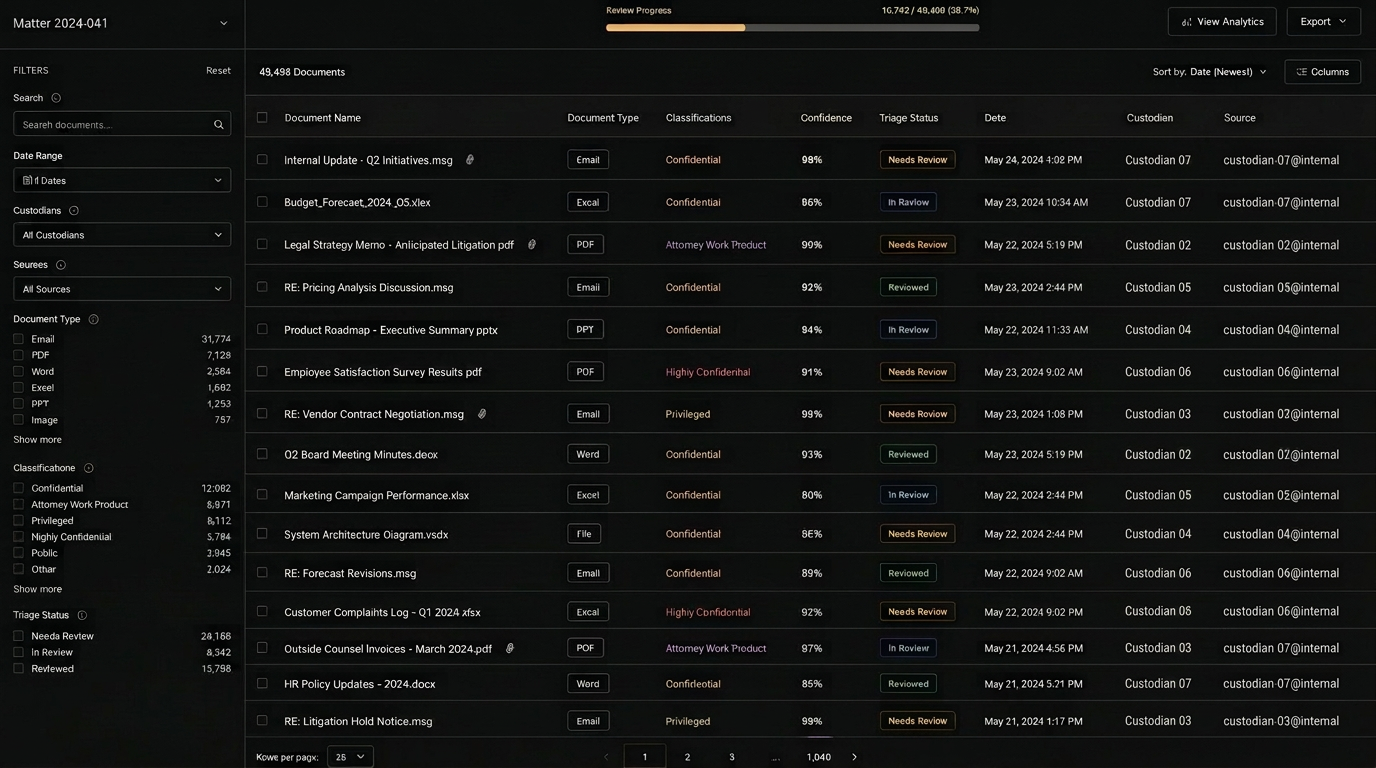
Aegir ingests case documents, classifies and tags each one against the case's evidence taxonomy, scores its own confidence, and triages the set: clean classifications flow through, uncertain ones queue for review with the reasoning attached.
Architecture
A document processing pipeline normalises each file — OCR where needed, structure extraction where possible — before classification. Each document gets a category, tags, a confidence score, and the extracted signals behind them, all stored so a reviewer can audit any decision after the fact.
Interface
The review screen is built around the queue: documents grouped by triage status, each showing its tags, confidence, and the passages that drove the classification. Accepting, correcting, or re-routing a document is one action — and corrections feed back into how future documents are tagged.
Intelligence
Classification is calibrated to abstain. The system is deliberately conservative about what it marks certain, because the cost model of legal review punishes false confidence far more than it punishes a longer review queue.
Execution
Designed and built the ingestion pipeline, classification and triage layer, and the review interface. The workflow shifted from 'read everything' to 'review what matters', with the audit trail intact for every automated decision.
Lessons
Confidence scores only work if the interface acts on them. Showing a number changed nothing until the queue, ordering, and default actions were all rebuilt around it.
Outcome
Review teams start from an organised, triaged evidence set instead of a raw dump: routine classification is handled by the system, and attorney time concentrates on the documents that actually need judgement.
Architectural insight
In evidence work, a confident wrong answer is the most expensive output a system can produce — designing the handoff to humans is the core of the product.